From 20 Years in Software Factories to a Remote Product Role in Europe: Sebastián’s Next Career Leap


After more than 20 years in software engineering, Sebastian Zunini had already achieved what many developers aim for:
- Architect roles
- Leading teams
- Building systems for U.S. banks and global companies
- Working with international clients for years
And yet, he still wanted something new.
This year, Sebastián landed a 100% remote Senior Product Engineer role with a multinational Spanish company, working on distributed systems and scalable architecture.
But the most interesting part of his story isn’t the offer.
It’s why he decided to reinvent his career after two decades in tech.
🧠 The Difference Between Software Factory and Product Engineering
Most of Sebastián’s career was spent in software factories - companies that build software for clients.
These environments teach engineers to deliver fast and handle different projects.
But they also have limitations.
“Projects usually last one or two years. You rarely get the chance to deeply improve or evolve a system.”
That’s what Sebastián wanted to change.
Product companies operate differently:
- You own the system long-term
- You continuously improve architecture
- You optimise performance and scalability
- You develop deeper knowledge of the product
This shift-from delivery-focused engineering to product ownership—is becoming one of the biggest career moves senior engineers make.
It reminds me of Steve Jobs’ metaphor about consulting roles. Check it out if you haven’t seen it yet:
🧩 The Three Pillars That Shaped His Career
Looking back, Sebastián identifies three factors that allowed him to grow from junior engineer to software architect:
1️⃣ Deep Technical Study
At one point in his career, he deliberately paused to study architecture fundamentals:
- Layered architecture
- Domain separation
- ORM design
- Logging and system organization
“That moment of structured study helped me organise everything I had learned.”
This foundation later allowed him to grow into architecture roles.
2️⃣ Commitment and Ownership
Technical skill alone wasn’t enough.
What made the difference was reliability.
“Companies trust the engineer who always responds when there’s a problem.”
That commitment—showing up when systems break, taking responsibility, solving issues—often matters more than brilliance.
3️⃣ Continuous Learning
Even after decades in the industry, Sebastián realised the market had changed.
Modern interviews now expect knowledge of:
- Distributed systems
- Microservices architecture
- Scalability patterns
- System design trade-offs
- AI-assisted development
What worked six years ago is no longer enough.
🤖 AI Is Changing Interviews Too
One surprising change Sebastián noticed in recent interviews:
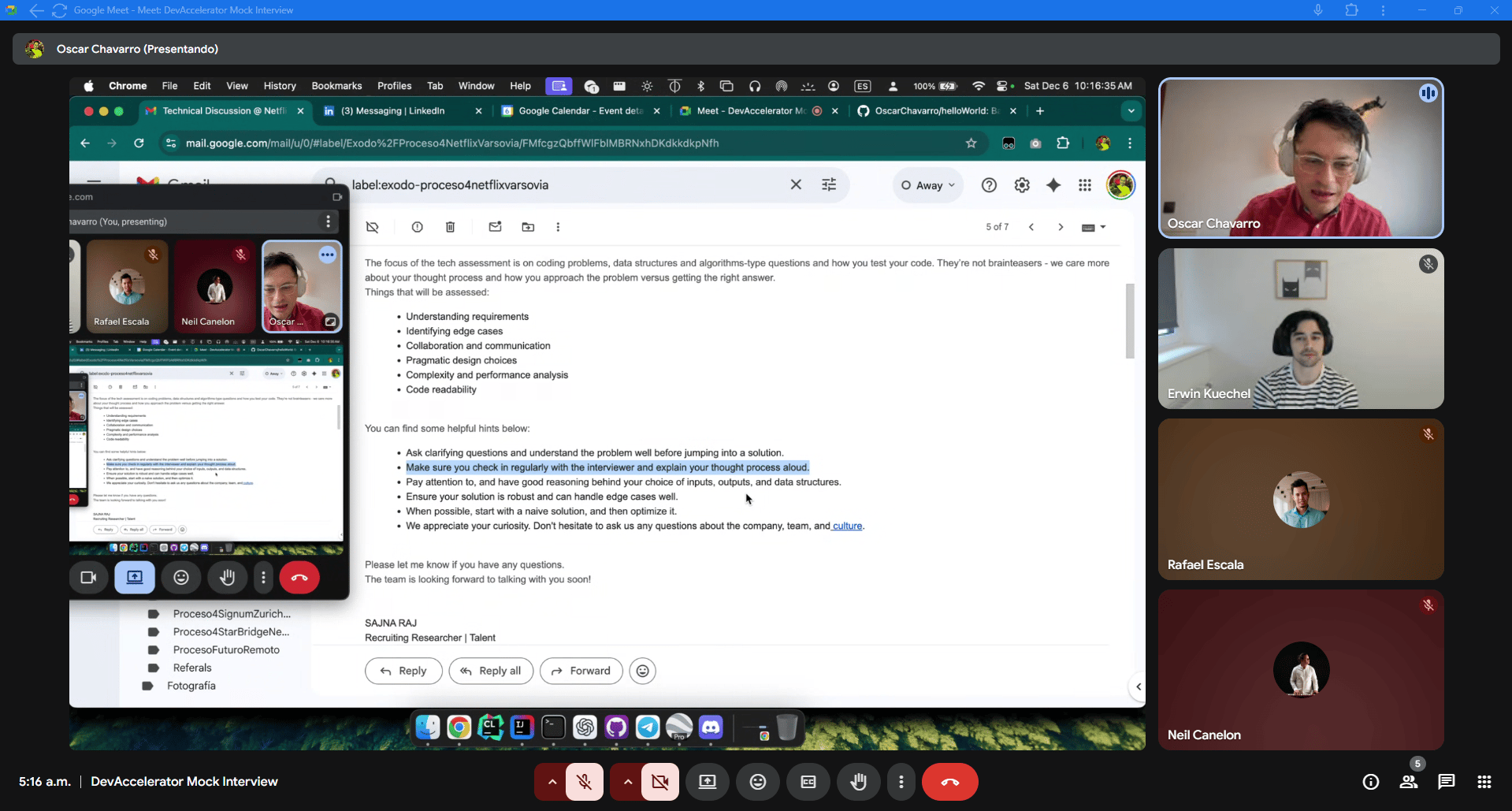
Companies now expect engineers to use AI tools during coding tasks.
But the key isn’t just generating code.
It’s explaining it.
“If you generate a solution with AI but can’t explain why it works, that’s a negative signal.”
The skill is no longer just coding.
It’s thinking, designing, and understanding systems deeply enough to guide AI tools.
🌍 The Hidden Career Multiplier: English
One point Sebastián emphasised repeatedly:
English remains one of the biggest career accelerators.
Even after years working with U.S. clients, he still sees it as a limiting factor for some opportunities.
“If you don’t speak English, you won’t access international roles.”
In global tech markets, English isn’t optional. It’s infrastructure.
🎓 Why Teaching Makes You a Better Engineer
Besides engineering, Sebastián also teaches programming at university.
And interestingly, he says teaching improves his engineering skills.
Helping beginners understand programming:
- Improves communication
- Strengthens conceptual clarity
- Forces you to explain complex ideas simply
“Sometimes a student asks a question that makes you rethink something you assumed was obvious.”
Teaching sharpens thinking.
🔭 What’s Next for Sebastián?
His goal now is clear:
Focus deeply on distributed architecture and system design.
In his new product role, he’ll work on:
- Microservices architecture
- Scalability improvements
- DevOps and pipelines
- System performance optimisation
- Feature development and product evolution
After two decades in software factories, he’s finally moving into the environment where systems evolve long-term.
And that’s exactly where architecture skills shine.
Final Thought
Sebastián’s journey highlights something important about senior engineers:
Career growth doesn’t stop after 10 or 15 years.
Sometimes the biggest leap comes after decades of experience-when you decide to reinvent yourself.
📢 Looking to hire experienced engineers with architecture and system design expertise for global teams?
We connect companies with highly experienced engineers ready for international product roles.
Recent Articles
Keep reading stories of teams that grew with us.